
Mulching the grass sward
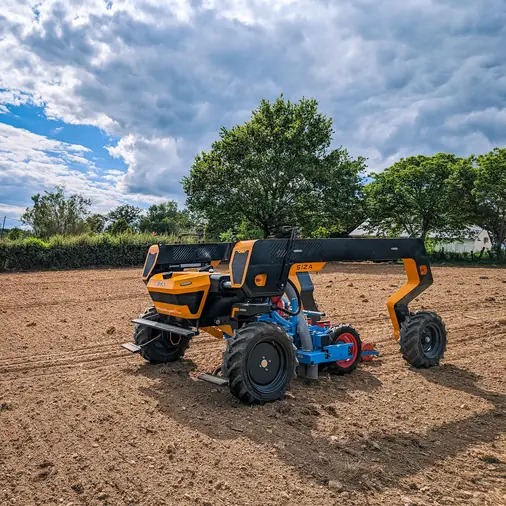
The farm's own mulcher, driven by the 540 rpm electric PTO, up to 18 kW. The most frequent maintenance job, handed over to the robot.
Mulching the grass sward, soil cultivation: in an orchard, maintenance passes come round all year. TOOGO handles them with your own tools, with no diesel between the trees, while your team concentrates on pruning and harvesting.
French orchards
In 2023, France had 128,500 ha of orchards and 11,798 fruit farms, a quarter fewer than in 2010. The average area rose from 8.4 to 10.9 ha. Apple remains the leading crop (36,651 ha) and walnut is growing strongly (33,600 ha).1
Labour, meanwhile, is still the biggest cost. A hectare of apple trees needs about 463 hours of work a year in France, and wages account for 40 to 60% of costs.2 Every hour freed up on maintenance is one more hour for pruning, thinning or harvesting.
And since October 2020, glyphosate has been banned in the inter-row of French orchards; under the row, its dose is limited to 900 g/ha/year.3 So the inter-row is managed by machine: count on 2 to 3 mulching passes a year, sometimes 4 depending on the grass sward.4
128,500 ha
of orchards in France in 2023
463 h/ha
of work per year in a French apple orchard
2 to 4
mulching passes a year in the grassed inter-row
Dimensions
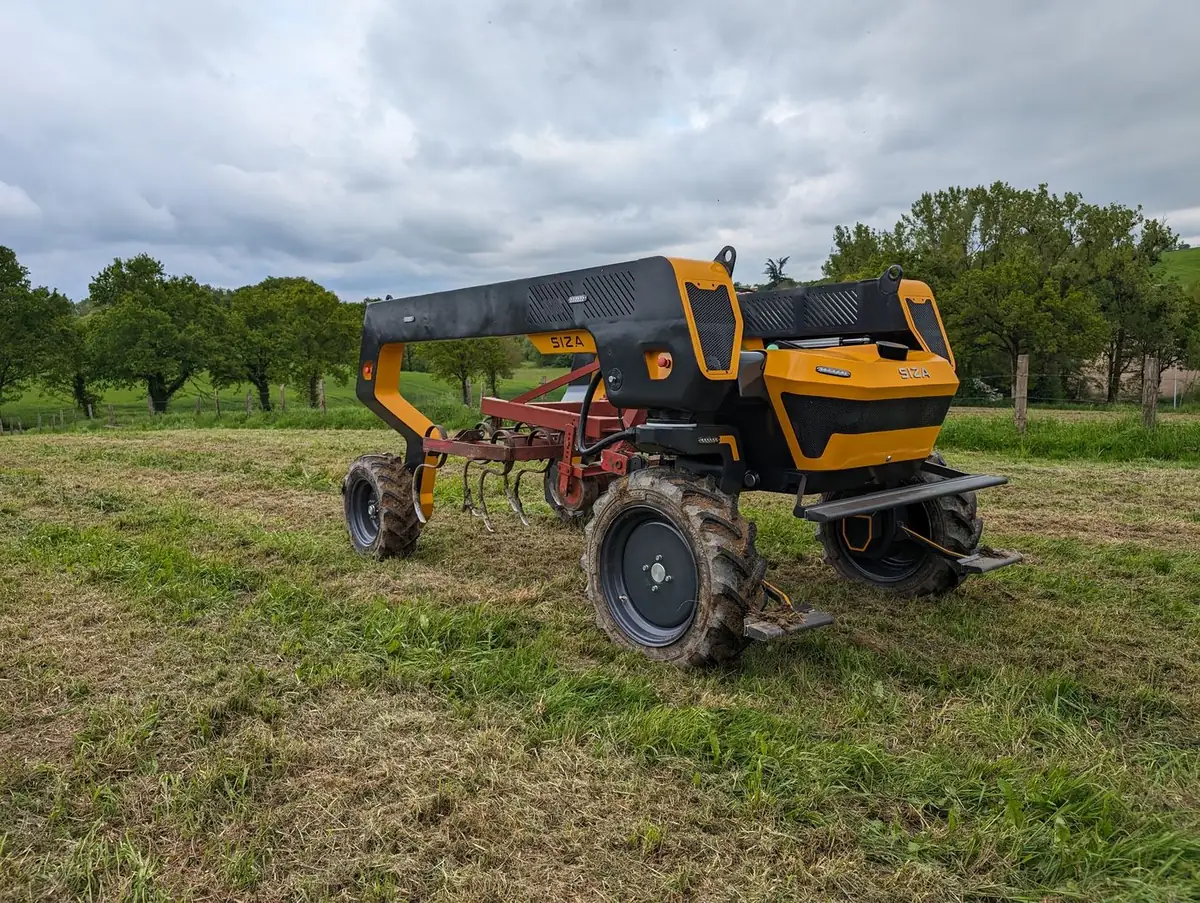
A modern apple orchard is often planted with around 4.50 m between rows, like the CTIFL trial orchard in France (4.50 × 1.50 m).5 TOOGO is 1.85 to 2.55 m wide depending on its track width, and 1.90 m high: it works in the inter-row with room to spare on each side.
The tool is hitched in the centre, between the wheels. It does not stick out beyond the machine's footprint: no risk of damaging a trunk or catching a trellis post when turning.
At the end of the row, two steering modes, zero turn and Ackermann, for turning round in less than 6 m. The suspension spreads the weight over all four wheels, and the radial tyres limit compaction.
Jobs
The farm's own mulcher, driven by the 540 rpm electric PTO, up to 18 kW. The most frequent maintenance job, handed over to the robot.
Tined tools, discs or a cultivator on the 1,600 kg Category 2 three-point hitch, in float mode to follow the ground. 18.5 kN of drawbar pull.
Bosch Rexroth Load-Sensing hydraulics: 2 double-acting outlets, 1 single-acting, 50 l/min and a free return, for hydraulically adjusted tools.
Maintaining the row is the hard part of herbicide-free fruit growing. At the Senura station in France (walnut), it costs about €75/ha with glyphosate and €90 to €95/ha with mechanical weeding.6 On TOOGO, it all depends on the under-row tool you hitch up and its ability to swing out around the trunks: let's talk about it with your equipment.
Safety
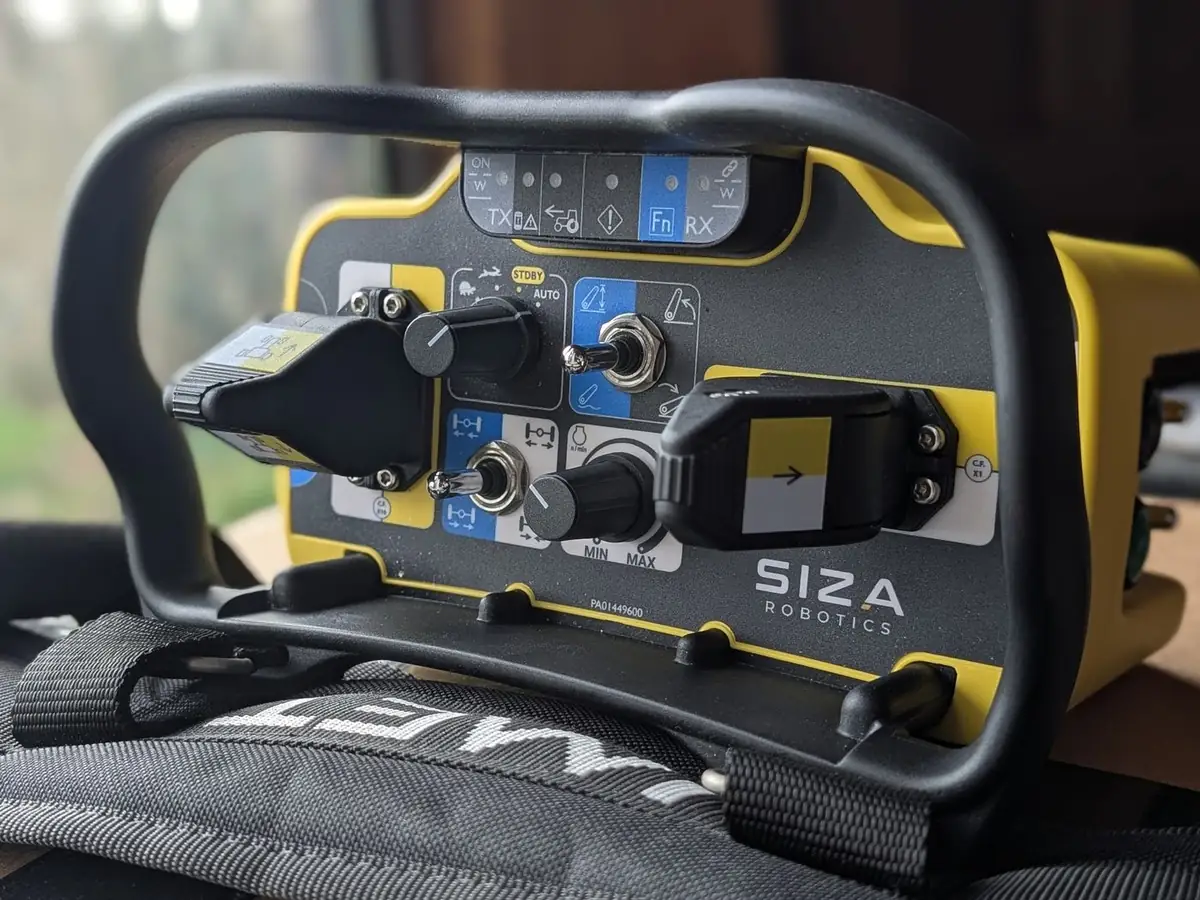
Pickers, pruners, visitors: an orchard sees a lot of people coming and going. TOOGO combines several layers of protection.
The market
Fruit growing is still not very robotised. Public trials in France focus mainly on row maintenance: from 2020 to 2023 the CTIFL tested a mowing robot in the apple tree row, with a cutting quality "equivalent to glyphosate" but an economic benefit that had yet to be demonstrated.5 Small mowing robots such as the Vitirover are also being tested at research stations.6
On the tool carrier side, SITIA's Trektor targets vineyards, orchards and market gardening. TOOGO focuses on the inter-row: mulching and soil cultivation with the tools already on the farm.
Yes, with its 540 rpm electric PTO, up to 18 kW. We check with you that your mulcher (width, weight, power required) is suitable before the demo.
TOOGO is 1.90 m high and 1.85 to 2.55 m wide depending on the track width. It works in the inter-row; the right configuration depends on how your orchard is trained and the height of the lowest scaffold branches.
TOOGO carries and guides the tools; work in the row depends on the implement and its ability to swing out around the trunks. It has to be looked at case by case with your equipment.
For now, an operator must be present to supervise autonomous operation. The unsupervised mode is being certified and will be offered as a free update.
See TOOGO in your orchard.
A demo on your farm, with your own mulcher.