
We build an agricultural robot, TOOGO. So we have a point of view. But a bad purchase harms the whole sector, and depending on your crops and your acreage, a machine other than ours may suit you better. This guide has one aim: to help you ask the right questions, of us and of everyone else.
Where does the market stand?
Agricultural robotics is still young, but it has changed scale. In France, around 600 robots work in crop production, compared with about a hundred in 2018. For comparison, there are some 17,000 milking robots.1
In France, viticulture and market gardening account for most of the fleet (around 280 and 250 robots in 2023), far ahead of field crops (around fifteen).2 Worldwide, around 3,000 robots have been sold for crop production, 60% of them tool carriers and 30% specialised robots.3
The sector is also taking shape financially, with acquisitions by large groups and a few failures: one more reason to look at the manufacturer's financial strength and the long-term availability of parts.
≈ 600
robots in crop production in France
× 6
between 2018 and 2023 (France)
60%
of robots sold worldwide are tool carriers
Types of agricultural robot
The word "robot" covers very different machines. There are five main families:
| Type | Principle | Who is it for? |
|---|---|---|
| Specialised weeding robot | Often a light machine, electric or solar-powered, with its own technology (tools, laser, micro-spraying) | Vegetables, sugar beet, small to medium areas |
| Autonomous tool carrier | Robot that carries and drives standard tools: three-point hitch, hydraulics, PTO | Farms that want one machine for several jobs and to keep their tools |
| Vineyard straddle robot | Robot that passes over the vine row | Narrow vineyards |
| Autonomous tractor | Automated high-power tractor, sometimes on tracks | Large areas, heavy draught work |
| Precision spraying | Weed detection and plant-by-plant treatment, often tractor-mounted | Reducing inputs in field crops and vegetables |
Weeding is the number one use for robots: we compare the technologies (mechanical, laser, micro-spraying) in a dedicated article, weeding robot: mechanical, laser or targeted?
The 8 criteria for choosing well
For each one, what to look at and the questions to ask. TOOGO serves as a worked example with figures, so that you can compare.
1. What job do you want it to do?
Everything starts here. Hoeing, weeding, drilling, soil cultivation, mulching: a specialised robot often does one thing very well; a tool carrier does several, with different tools. List your crops, your acreage, the width of your beds or inter-rows, and the number of weeks of use per year. A robot that is only used for three weeks is hard to pay off.
Questions to ask
- What jobs does the machine do, with which tools?
- What bed or inter-row widths can it handle?
- How many hectares per day, in conditions comparable to mine?
2. Can you keep your tools?
This is the most common hidden cost. Check the hitch category, the lift capacity, and whether there are hydraulics and a PTO. Example: TOOGO has a 1,600 kg Category 2 three-point hitch, 50 l/min Load-Sensing hydraulics and a 540 rpm PTO up to 18 kW; so it takes the tools of a mid-power tractor.
Questions to ask
- Hitch category, lift capacity, float mode?
- Hydraulics: how many outlets, what flow rate?
- PTO: what speed, what power?
3. What is the real run time?
A run time quoted without conditions means nothing. Ask for the tool, speed and slope used for the measurement, as well as the charging time and type. Example: TOOGO quotes up to 12 h hoeing or drilling at 4 km/h on an average 8% slope, with charging from 0 to 90% in 2 h. A solar-powered robot, on the other hand, depends on sunshine and often stops in the rain.
Questions to ask
- Run time measured with which tool, at what speed, on what slope?
- Charging time, type of socket?
- Battery capacity after several years?
4. What accuracy, and at what cost?
To hoe as close to the row as possible, you need 2 to 3 cm accuracy, which means RTK.4 In France, RTK equipment on a tractor costs at least €10,000, plus implement guidance and an annual subscription; a camera for an inter-row hoe costs €15,000 to €25,000.5 Look at what is included, and how the tool is re-centred while working: side-shift, camera, or both?
Questions to ask
- Stated accuracy, guidance technology?
- Tool correction while working?
- RTK subscription included, optional, or at your expense?
5. What safety, what level of autonomy?
Obstacle detection, safety edges, emergency stops, virtual fence: ask for the full list and for compliance with standards (see regulation). And ask clearly whether the machine can work unsupervised today, or whether that is a promise. For TOOGO, the answer is clear: an operator supervises today, and the unsupervised mode is being certified.
Questions to ask
- Which sensors, how many emergency stops?
- Is supervision required or not, today?
- Protection against theft and vandalism?
6. How does it get from one plot to the next?
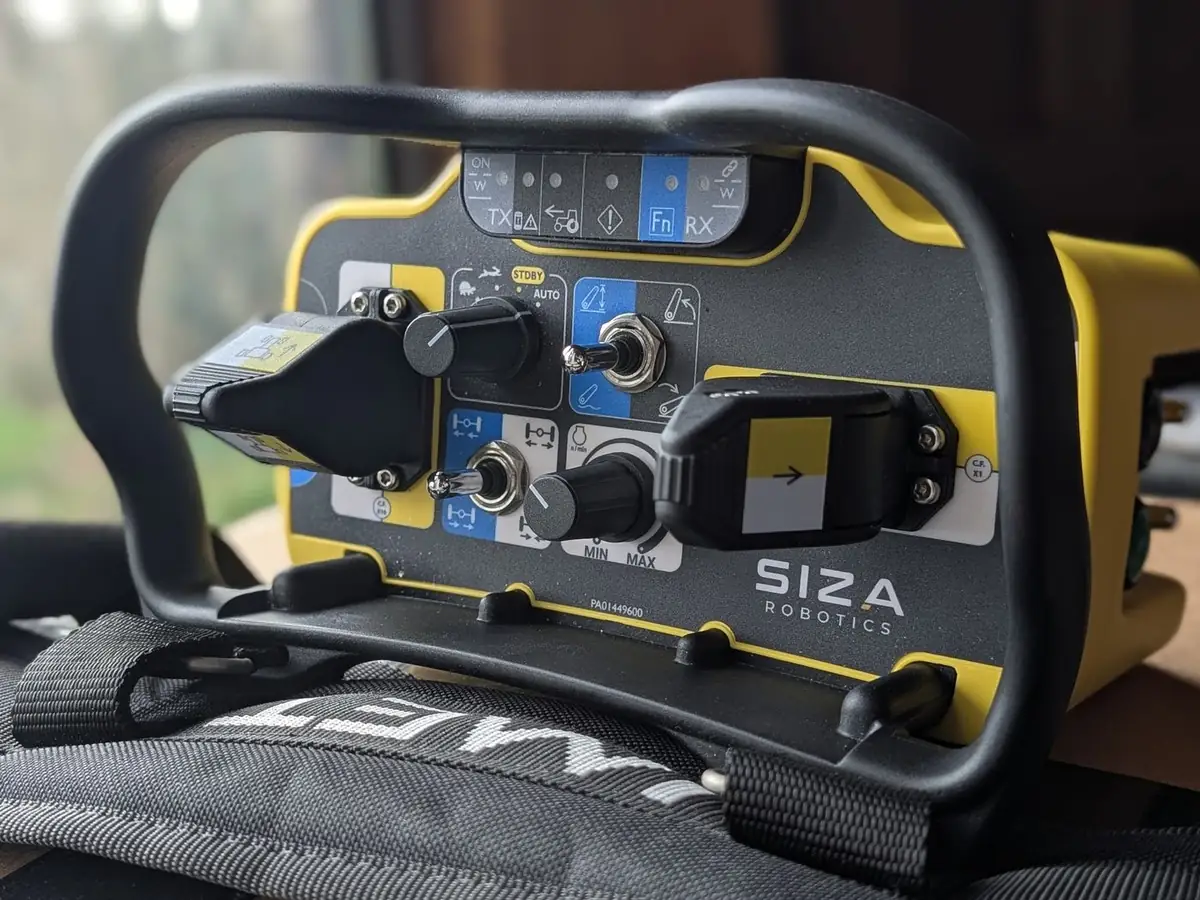
The IFV's vineyard trials in France identified transport between plots as one of the main barriers to robot adoption.6 An autonomous robot cannot travel on public roads by itself: it has to be driven by radio remote control or loaded onto a flatbed trailer. Example: TOOGO drives at 12 km/h by radio remote control and closes its track width to go up onto a flatbed trailer.
Questions to ask
- Transport width, loading onto a flatbed trailer?
- Speed and range of the remote control?
- Turning radius at the end of the row?
7. Who provides the service, and for how long?
Commissioning (mapping the plots, training, first jobs) determines success. The IFV trials allow at least one hour per hectare for initial mapping.6 Also ask who comes out in the event of a breakdown, how quickly, and for how many years parts will be available. Example: TOOGO, on-site training, 24/7 hotline, inspection before each season, parts and updates for 10 years.
Questions to ask
- Commissioning and training included?
- Call-out time, remote support?
- How long will parts be available, standard or proprietary parts?
8. What is the total cost?
Compare the full cost over time: purchase price, tools to buy again or not, energy, maintenance, subscriptions (RTK, software), available subsidies. See the price and return on investment section and our page on French purchase subsidies (in French).
Questions to ask
- Price of the configuration I need?
- Any compulsory subscriptions?
- What subsidies could my farm get?
Manufacturer overview
The main manufacturers active in France and Europe, by type of machine. France is one of the most active countries in agricultural robotics, with many manufacturers and a national "grand challenge" run by the RobAgri association.7
| Manufacturer | Machine | Type and principle |
|---|---|---|
| Naïo (France) | Oz, Ted | Electric robots: weeding in market gardening (Oz), vineyard straddle robot (Ted) |
| Carré (France) | Anatis | Electric hoeing robot guided by GPS and LiDAR |
| FarmDroid (Denmark) | FD20 | Solar-powered sowing and weeding robot |
| Farming Revolution (Germany) | Farming GT | Electric mechanical weeding using image recognition |
| Pixelfarming Robotics (Netherlands) | Robot One | Laser weeding guided by artificial intelligence |
| Kilter (Norway) | AX-1 | Micro-droplet weeding, vegetables on beds |
| Ecorobotix (Switzerland) | ARA | Plant-by-plant precision sprayer, tractor-mounted |
| VitiBot (France, SDF group) | Bakus | Electric vineyard straddle robot |
| Exxact Robotics (France) | Traxx | Autonomous vineyard straddle robot |
| SITIA (France) | Trektor | Hybrid autonomous tractor for vineyards, orchards and market gardening |
| AgreenCulture (France) | CEOL | Hybrid tracked weeding robot; autonomy kits for other manufacturers |
| Sabi Agri (France) | ALPO | Compact electric tractor, capable of autonomous operation |
| AgXeed (Netherlands) | AgBot | High-power diesel-electric autonomous tractor |
| SIZA Robotics (France) | TOOGO 2.0 | Electric tool carrier with adjustable track width: Cat. 2 hitch, hydraulics and PTO for existing tools |
Compiled in September 2026 from manufacturers' public information and the farming press. Not an exhaustive list; ranges change, so check with each manufacturer. The brands mentioned belong to their respective owners; SIZA Robotics has no connection with the other manufacturers listed.
Price and return on investment
Few manufacturers publish their prices. Some public reference points: a solar-powered sowing and weeding robot costs between €75,000 and €100,000 depending on equipment8; a 3.60 m laser weeding robot is listed at €355,0009. TOOGO 2.0 is available from €129,000 excl. VAT, with no RTK subscription.
Return on investment depends mainly on the number of hours worked per year and on what the robot replaces: driver hours, hand weeding, herbicides, diesel. In sugar beet in France, an ARTB-ITB study of a solar-powered robot measured −34% TFI, −€167/ha in herbicides and −27% working time, but also +32% in mechanisation costs.8 Hence the value of a machine that does several jobs, and of investment subsidies: see French purchase subsidies (in French).
Regulation: the rules for robots
Machinery Directive, then Machinery Regulation
Today, robots fall under Directive 2006/42/EC, which does not deal specifically with autonomy. The EU Machinery Regulation 2023/1230 replaces it from 20 January 2027, with no national transposition. It defines "autonomous mobile machinery" and adds requirements on supervision, movement and cybersecurity.10
The ISO 18497:2024 standard
It covers the safety of partially automated, semi-autonomous and autonomous agricultural machinery, in four parts: design principles, obstacle protection, autonomous operating zones, verification and validation.11
Road travel and supervision
Under current French law, an autonomous robot works on a private plot; it does not travel on its own between plots or on public roads, except in authorised trials.12 The level of supervision required depends on each machine's conformity: ask the manufacturer what is certified today.
Glossary
- RTK
- Real-time correction of satellite positioning (GNSS), for accuracy of around 2 cm. Works day and night.
- Tool carrier
- Machine that hitches, carries and drives agricultural tools, like a tractor.
- Category 2 three-point hitch
- Standardised three-point linkage, used on mid-power tractors.
- Float mode
- The hitch lets the tool follow the ground contours freely.
- PTO (power take-off)
- Rotating shaft that drives powered tools (power harrow, mulcher, etc.), usually at 540 rpm.
- Load-Sensing
- Hydraulics that adjust the flow to the tool's demand, to limit energy losses.
- LiDAR
- Laser sensor that measures the surroundings in 3D to detect obstacles.
- Geofencing
- GPS virtual fence that the robot cannot cross.
- TFI
- Treatment frequency index (IFT in French): it measures how intensively plant protection products are used.
- Track width
- Distance between the wheels on the same axle. On TOOGO, it adjusts from 1.50 m to 2.20 m.
Frequently asked questions
How many agricultural robots are there in France?
Around 600 robots work in crop production in France (not counting milking robots, of which there are about 17,000), according to Axema in 2025. There were around a hundred in 2018.
How much does an agricultural robot cost?
From a few tens of thousands to several hundred thousand euros. Among published prices: €75,000 to €100,000 for a solar-powered sowing and weeding robot, €355,000 for a 3.60 m laser weeding robot. TOOGO 2.0 is available from €129,000 excl. VAT.
Can an agricultural robot work unsupervised?
It depends on the machine and its conformity. The EU Machinery Regulation 2023/1230, applicable from January 2027, covers autonomous mobile machinery. For TOOGO, autonomous operation currently requires an operator supervising; the unsupervised mode is being certified.
Can an agricultural robot drive on the road by itself?
No. Under current French law, an autonomous robot works on a private plot; it does not travel on its own between plots or on public roads, except in authorised trials.
What is the difference between an agricultural robot and an autonomous tractor?
An autonomous tractor takes the architecture of a tractor, often a high-power one, and automates it. An agricultural robot is designed around the task: lighter, often electric, with the tool placed where it is most precise.
Sources
- Axema, « La robotique agricole, un nouveau chapitre pour l'agriculture », 19/03/2025 (in French). Link
- La France Agricole, « Après les stabulations, les robots s'attaquent aux champs », 2023 (in French). Link
- Entraid, « FIRA : robots agricoles 2025 », 13/02/2025 (in French). Link
- Arvalis, « Maïs : réduire l'utilisation d'herbicides grâce au binage », 11/05/2023 (in French). Link
- Terre-net, « Binage : quel système de guidage de précision choisir ? », 01/07/2022 (in French). Link
- Vitisphere, « Premiers chiffres de performance des robots viticoles pour le désherbage » (IFV trials), 15/05/2024 (in French). Link
- French Ministry of Agriculture, « RobAgri, l'association qui regroupe les acteurs de la robotique agricole en France » (in French). Link
- Le Betteravier français, « Robot FarmDroid : quelle place en betterave conventionnelle ? », 16/03/2026; paysans.fr, comparison of weeding robots, 13/08/2026 (in French). Link
- Future Farming, « Pixelfarming Robot One: chemical-free weed control ». Link
- RobAgri, « Règlement UE 2023/1230 : ce que les constructeurs de robots agricoles doivent anticiper » (in French). Link
- ISO, ISO 18497:2024 standard. Link
- RobAgri, « Robots agricoles et circulation sur route : ce que dit le droit aujourd'hui » (in French). Link